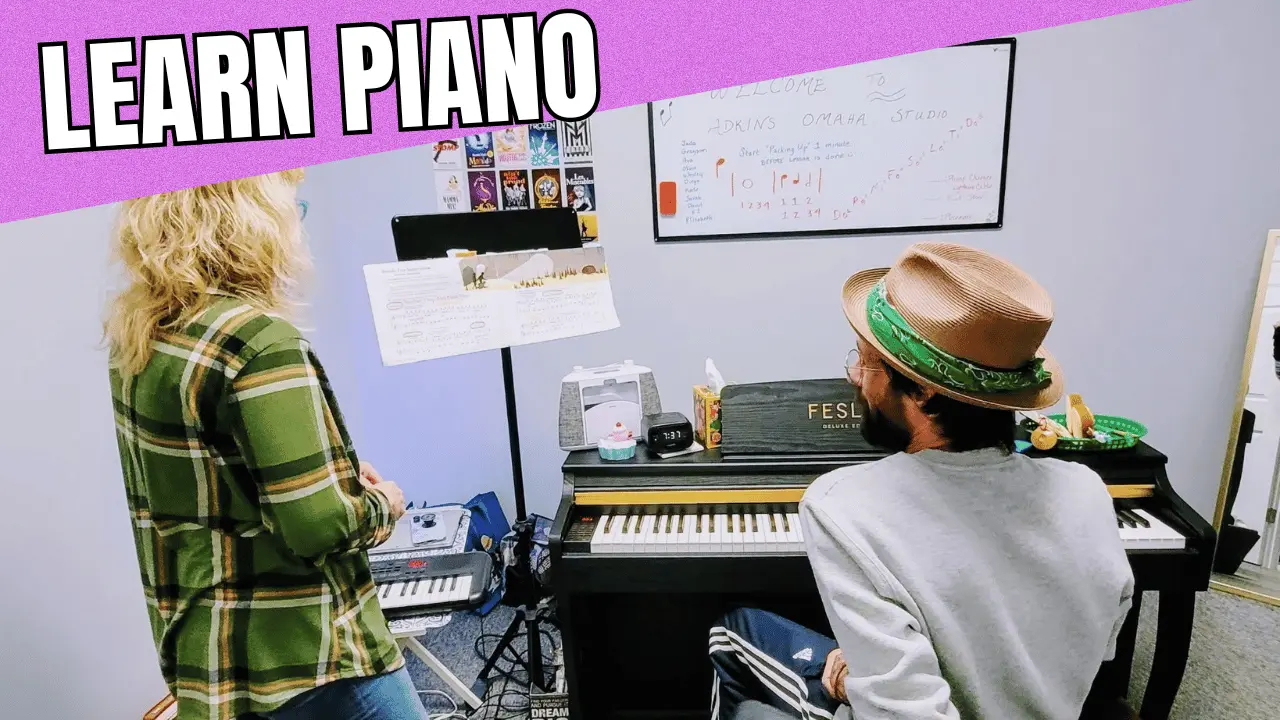
Many families in the Millard and Dundee neighborhoods of Omaha are looking for enriching activities for their children, and learning piano often tops the list. While the idea of reading sheet music might seem like a complex hurdle, it's actually a foundational skill that opens up endless possibilities for progress right here in our community.
This guide is designed specifically for beginner piano players, breaking down the essential elements of sheet music into easy-to-understand concepts. We'll cover everything from identifying notes on the staff to understanding basic rhythms, giving you a clear roadmap to start playing your favorite tunes with confidence.
Decoding the Grand Staff: Treble and Bass Clefs
The first step to reading piano sheet music is understanding the grand staff, which combines the treble clef (for higher notes, played with the right hand) and the bass clef (for lower notes, played with the left hand). Think of it like a musical map for your hands. Each line and space on these staffs represents a specific note, and memorizing their positions is crucial. Many students at our Omaha studio find mnemonic devices like 'Every Good Boy Does Fine' for treble clef lines incredibly helpful.
For piano, you'll often see both clefs connected by a brace, indicating that they are played simultaneously. The middle C note acts as a bridge between the two, sitting on its own ledger line. Practicing identifying notes on both clefs daily, perhaps with flashcards or an app, will build your recognition speed and make sight-reading much smoother.
Understanding Note Values and Rhythms
Beyond just knowing *what* note to play, you need to know *how long* to play it. This is where note values and rhythms come in. Whole notes, half notes, quarter notes, and eighth notes each have a specific duration, determined by the time signature at the beginning of the piece. For example, in 4/4 time, a quarter note gets one beat, a half note gets two, and so on. This rhythmic foundation is vital for playing in time and making your music sound cohesive.
Counting out loud while you play, or even just tapping your foot, is an excellent way to internalize rhythm. Many beginner piano students at Adkins Music Lessons near Aksarben Village start with simple pieces that have clear, repetitive rhythms. Consistent practice with a metronome will help you develop a strong internal pulse, which is indispensable for any musician.
Dynamics, Articulation, and Expression Marks
Sheet music isn't just about notes and rhythms; it's also a guide to musical expression. Symbols for dynamics (like 'p' for soft or 'f' for loud), articulation (like staccato dots or legato slurs), and tempo markings (like 'Allegro' for fast or 'Andante' for walking pace) tell you *how* to play the music. These elements transform a series of notes into a vibrant, emotional performance.
Paying attention to these expressive markings is what truly brings a piece to life. It's the difference between simply hitting the right notes and performing with feeling. Our instructors at the UNO campus area location emphasize interpreting these symbols from the very first lesson, encouraging students to experiment with different levels of touch and expression to find their unique musical voice.
Piano Lessons in Omaha
Private one-on-one lessons, all ages, all levels. No long-term contracts.
Email adkinsguitarandmusic@gmail.com.
Sign Up for Piano Lessons →Helpful Next Steps
Not sure which lesson is right? Start with your closest studio and the instrument your student is most excited to try.
Have a question first? Email adkinsguitarandmusic@gmail.com — Zach reads it himself.
Powered by: ZiroWork helps organize the systems behind this site.