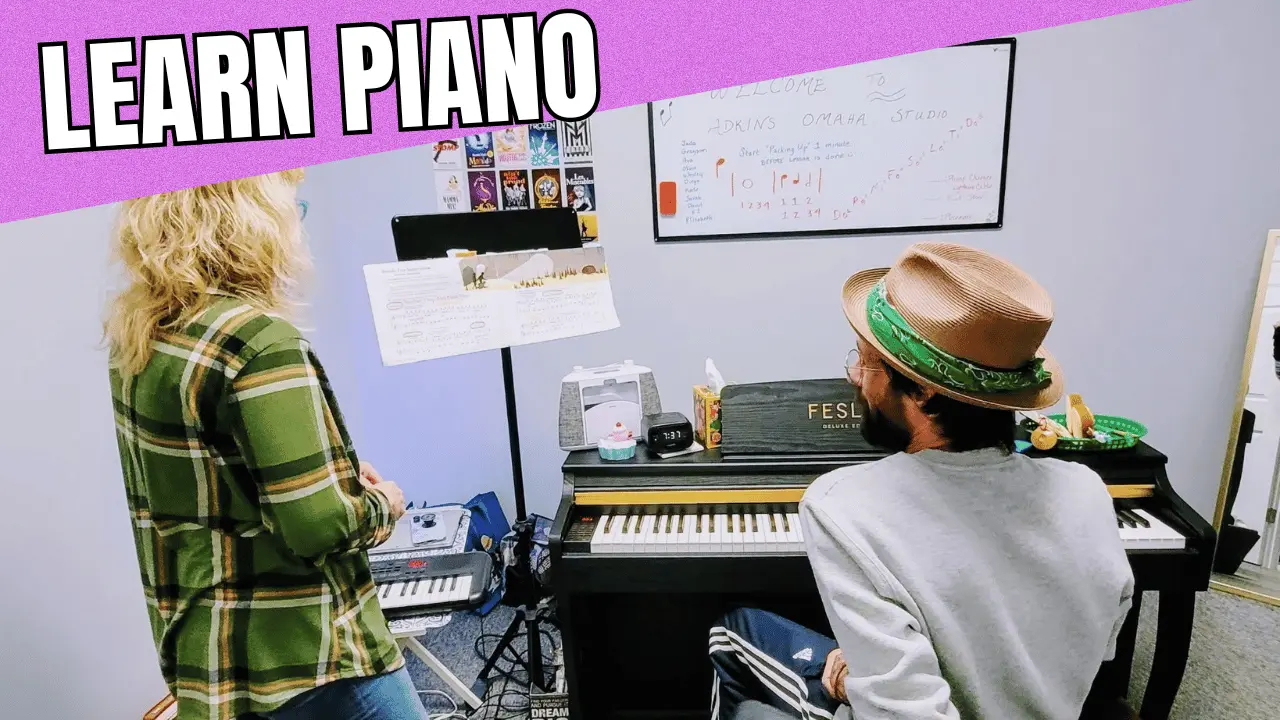
If your kid wants to play piano across Southwest Omaha and the Millard area, the journey to musical mastery often hits a fascinating, yet frustrating, roadblock: hand independence. It's that moment when your left hand wants to play a bass line while your right hand dances with a melody, and your brain feels like it's short-circuiting. At Adkins Music Lessons, we understand this unique challenge that many students, from Millard Public Schools to UNO campus, encounter.
Hand independence isn't just about playing two different rhythms; it's about developing separate neural pathways and muscular control for each hand, allowing for complex musical expression. While it feels counterintuitive at first, building this skill is fundamental to unlocking a vast repertoire of piano music and elevating your playing to new heights.
The Brain's Challenge: Why Hand Independence Feels So Hard
Our brains are naturally wired for coordination, not necessarily for independent, simultaneous actions from two separate limbs. When you first sit down at the piano, your hands tend to mirror each other or work in unison. This is efficient for simple tasks, but music often demands intricate, contrasting movements. The challenge intensifies when one hand needs to maintain a steady rhythm while the other executes a rapid, complex passage, or when different dynamics are required from each hand.
This cognitive load is why many students in areas like Aksarben Village or Dundee find themselves stuck. It requires conscious effort to override the brain's natural tendency to synchronize, and instead, teach it to manage two distinct musical conversations at once. It's a mental workout that builds new neural connections, making it a cornerstone of advanced piano technique.
Foundational Drills for Omaha Pianists: Building Separate Control
To conquer hand independence, we start with isolation. Begin by practicing each hand's part separately, ensuring complete accuracy and fluidity before attempting to combine them. A great exercise is playing a simple scale or arpeggio with one hand while the other rests, then switching. Once comfortable, introduce rhythmic variations: play quarter notes with the left hand and eighth notes with the right, then reverse. This helps the brain recognize and internalize distinct rhythmic patterns for each hand.
Another effective technique is 'shadow playing' or 'air piano' where one hand plays on the keys while the other mimes its part just above the keys. This allows you to focus on the physical motion and mental rhythm of each hand without the added pressure of sound production from both. Students near Westroads Mall can incorporate these drills into their daily practice, building a solid foundation for more complex pieces.
Progressive Techniques: Combining Hands with Purpose
Once individual hand control is established, the next step is to combine them gradually. Start with slow tempos, focusing on precision over speed. Use a metronome religiously, ensuring each hand's rhythm is perfectly aligned. When combining, pay close attention to the points where the hands interact or diverge, as these are often the trickiest spots. Practice these sections in small, manageable chunks, gradually increasing the length of the combined passage.
For students attending Burke High School or living in the Elkhorn area, incorporating pieces specifically designed to challenge hand independence can be highly beneficial. Look for études or exercises that feature polyrhythms or contrasting melodic lines. Regular, focused practice with these techniques, combined with expert guidance from an Adkins Music Lessons instructor, will steadily build the coordination and confidence needed to achieve true hand independence.
Piano Lessons in Omaha
Private one-on-one lessons, all ages, all levels. No long-term contracts. Sign up today at our Omaha studio.
Email adkinsguitarandmusic@gmail.com.
Sign Up for Piano Lessons →Helpful Next Steps
Not sure which lesson is right? Start with your closest studio and the instrument your student is most excited to try.
Have a question first? Email adkinsguitarandmusic@gmail.com — Zach reads it himself.
Powered by: ZiroWork helps organize the systems behind this site.